English
 Türkçe


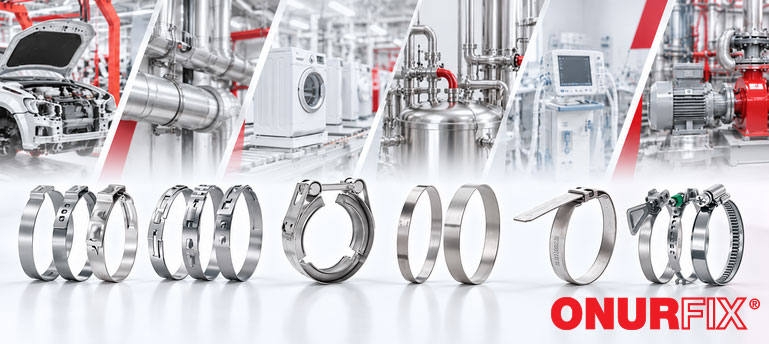
In industrial systems, securing a hose firmly to its connection helps control fluid transfer and keep the connection suited to its operating conditions. A hose clamp is a fastening component used to secure a hose around a fitting, connector, or port and to create the clamping force required by the application. The right clamp should be selected by considering the hose construction, connection geometry, and system conditions together. This guide covers hose clamp types, applications, selection criteria, and key installation considerations.
What Types of Hose Clamps Are Available?
Hose clamps are made in different designs according to their tightening mechanism, geometry, and intended use. The installation method, diameter range, clamping force, and whether a clamp can be reopened vary by model. Product selection should therefore be based on technical requirements, not only on a clamp’s name or appearance.
Ear Clamps
Ear clamps create compression around a hose when the ear is closed with a suitable installation tool. This design can be used in production processes that require fast, repeatable assembly. Specially formed, burr-free edges and the clamp geometry can help reduce the risk of damage to the clamped component when the correct product and installation method are used. These clamps may be suitable for automotive, heating and cooling, fluid transfer, and various industrial assembly applications. Use the tool required for the product and follow the manufacturer’s instructions.
Low-Profile Hose Clamps
Low-profile hose clamps are designed for some applications where installation height and surrounding clearance are limited. Depending on the model, they may reduce protrusion or imbalance around rotating components. This feature is not identical across all low-profile clamps, so suitability for moving or rotating systems should be confirmed in the relevant product documentation. Required clamping force and operating conditions should be considered alongside dimensions.
Screw and Universal Hose Clamps
Screw hose clamps are tightened through a screw mechanism. Within the product’s diameter range, the fit and tightening force can be adjusted in a controlled way; in some applications, the clamp can also be reopened for maintenance. Models described as universal may be used within a specified diameter range, depending on their design. Consider the band construction, material, edge finish, and the manufacturer’s tightening instructions. Excessive tightening can damage the hose, so follow the installation guidance.
Reducible Ring Clamps
Reducible ring clamps are designed to provide circumferential compression. When the product geometry and installation method are suitable, they can create a balanced surface-pressure distribution around the connection. Some models are developed for specific applications, such as heating and cooling water circuits or airbag systems. These examples do not apply to every ring clamp; the correct diameter, material, and installation method must be determined from the product specifications.
Hanger and Profile Clamps
Hanger clamps are used where certain hoses or lines need to be supported and positioned. Profile clamps address specific fastening requirements through their shaped geometry. These products may not serve the same function as clamps that compress a hose onto a connection to create a seal. Confirm the intended use and load requirements in the product documentation.
Where Are Hose Clamps Used?
The applications for hose clamps depend on the product’s material, design, and technical capacity. Suitable products may be used in areas such as:
• Automotive: suitable fluid and air lines, cooling circuits, and some auxiliary systems.
• Heating and cooling: fluid-carrying circuits and related hose connections.
• Home appliances: water and air line connections compatible with the product design.
• Food and beverage: only products verified as suitable for fluid contact, cleaning conditions, and the application’s hygiene requirements.
• Medical: specialized connection solutions whose materials, design, and required conformity documentation have been verified for the application.
• Industrial machinery: equipment where hose connections must be secured in accordance with operating conditions.
Do not assume that the same clamp model is suitable for every sector or system. Fluid, temperature, pressure, vibration, and environmental factors should all be considered during product selection.
How to Choose the Right Hose Clamp
Hose diameter alone is not enough to select a hose clamp. Review the following criteria together to support connection reliability and operating performance.
Hose Diameter and Connection Size
Determine the outside diameter of the hose once it is fitted to the connection, as well as the operating diameter range of the clamp. Take measurements using the method specified by the manufacturer. A clamp that is the wrong size may not provide sufficient compression or may put unwanted pressure on the hose.
Pressure and Temperature Conditions
Consider the system’s operating pressure and temperature range alongside the limits of the hose and other connection components. Matching the hose diameter alone is not sufficient; the product’s technical ratings must meet the application’s conditions. In pressurized systems, verify the compatibility of the hose, fitting, clamp, and installation method against manufacturer recommendations and system requirements. Do not infer a general pressure rating from the clamp type alone.
Material and Environmental Conditions
Moisture, corrosion risk, chemicals, cleaning methods, and outdoor exposure affect material selection. Clamps made from stainless steel or other materials may suit different environments depending on their properties. Check fluid contact, environmental conditions, and the product’s technical documentation.
Vibration and Movement
For systems exposed to vibration, impact, or temperature changes, assess the connection’s resistance to loosening and its sealing performance. The clamp’s locking design, connection geometry, and application conditions should be included in this assessment.
Installation Method and Maintenance Needs
To achieve the expected performance, a suitable clamp must be positioned correctly and installed in accordance with the manufacturer’s instructions. Incorrect positioning, unsuitable tightening force, or the wrong tool can affect connection performance. During installation:
• Check that the hose and connection surfaces are in suitable condition for the application.
• Position the clamp as specified by the manufacturer and follow the installation instructions.
• Avoid crushing or damaging the hose through excessive tightening.
• Use the appropriate equipment for clamps that require a special tool.
• After installation, inspect the connection using methods suited to the operating conditions and relevant safety procedures.
Installation and inspection of pressurized systems should be carried out by qualified personnel in accordance with the safety procedures for the application.
The Importance of Hose Clamp Design and Quality
A clamp’s geometry, material, edge construction, and locking mechanism can affect clamping performance and suitability for the connection’s operating conditions. Some designs, for example, aim to distribute pressure more evenly around the connection through 360 degrees. On certain models, specialized locking mechanisms can help maintain compression and improve resistance to expansion, impact, or vibration. Low-profile designs can also benefit space-constrained installations when the specifications of the particular model allow it. Since these features are not present in every model, review catalogue ratings, installation instructions, and application requirements together.
Frequently Asked Questions
How do I determine the correct hose clamp size?
Determine the size by considering the outside diameter of the hose when fitted to its connection and the clamp’s operating range specified by the manufacturer. Confirm the measurement and installation diameter using the product’s technical instructions.
What is the difference between an ear clamp and a screw hose clamp?
Ear clamps are tightened by closing the ear with a special tool. Screw hose clamps are adjusted through a screw mechanism. The right choice depends on assembly volume, maintenance needs, diameter range, and application conditions.
Can a hose clamp be reused?
This depends on the clamp design and the manufacturer’s instructions. Do not assume every model is reusable; check the product documentation for approval of removal and reinstallation.
Can any hose clamp be used in a pressurized system?
No. For pressurized applications, the hose, fitting, clamp, and installation method must be assessed together. Verify suitability and operating limits using the relevant manufacturers’ technical information.
Onurfix Hose Clamp Solutions
The Onurfix product portfolio includes ear, low-profile, profile, reducible ring, hanger, screw, and universal hose clamp groups. When identifying a suitable product, consider connection diameter, operating temperature, pressure conditions, installation space, and intended use together. To learn more about the available products and options for your application, visit the Onurfix Hose Clamps product page or contact the sales team.