English
 Türkçe


Fasteners used in the aviation industry are selected by considering weight, strength, vibration, corrosion and maintenance requirements together. Rivets, panel locks, hinges and access hardware serve a range of applications, from airframe and interior trim installations to maintenance panels.
Choosing the right product involves more than looking at the material type. The location where the part will be used, the materials being joined, the expected loads and the manufacturer’s documentation are also part of the selection process. In aviation, a product’s suitability must be verified for each product and application.
Why does rivet material matter in aviation?
Aluminium alloys are common options for solid rivets used in aircraft structures. The FAA’s aircraft maintenance and repair guidance covers the 1100, 2117, 2017, 2024 and 5056 alloys. These alloys differ in strength and application. For example, 2117 alloy rivets are among the commonly used options in aircraft construction. Rivets made from 2017 and 2024 alloys may be considered for some applications requiring higher strength, while 5056 alloy is used to join magnesium-alloy sheets. Alloy 1100 may be selected where lower strength is sufficient. In every case, the appropriate alloy should be determined according to the design, loads and maintenance requirements.
Blind rivets can simplify installation where access is available from only one side. Onurfix’s rivet range includes aluminium, steel and stainless-steel options. However, whether a blind rivet is suitable for an aviation application must be verified against the project requirements, approved design and manufacturer documentation, in addition to the product’s size and material.
The following factors should be considered together when selecting a rivet:
- Materials and combined thickness of the parts being joined
- Required diameter, grip range and head type
- Loads and vibration to which the joint will be exposed
- Corrosion and effects that may result from contact between dissimilar metals
- The product’s technical documentation and any approvals required for the application
Material selection for Southco locks and hinges
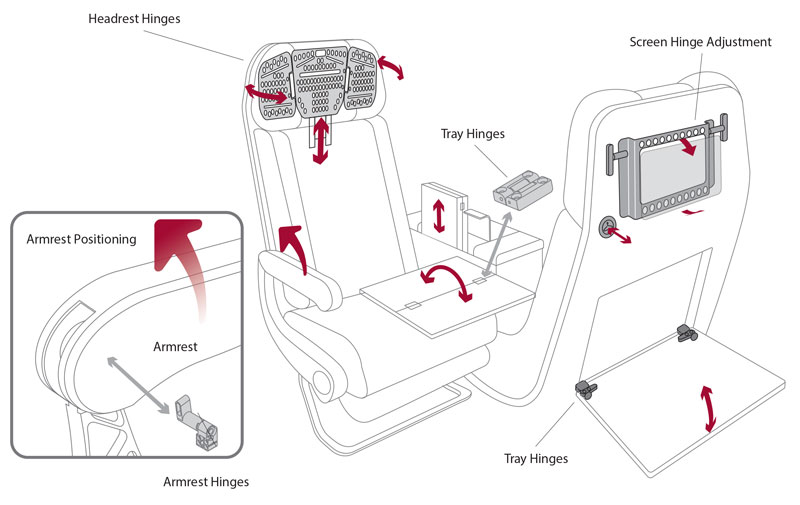
Southco’s aviation solutions include hinges and quarter-turn fasteners, as well as panel-access and locking systems. Product families may offer different material options, such as aluminium alloy and stainless steel; the material used depends on the model and configuration.
For example, on some of Southco’s EH surface-mount hinge models, the hinge leaves are made of aluminium alloy and the pin is made of stainless steel. This type of material combination makes it possible to address weight and strength requirements together. However, the material and performance specifications of each hinge should be checked against its product code.
The DZUS® D5 quarter-turn fasteners used for panel access are also available in aluminium-alloy and stainless-steel options. Southco states that certain products in the D5 family meet aviation requirements. This does not mean that every D5 product or configuration in the same series automatically has aviation approval; suitability should be verified using the selected product code.
Material configurations can also vary by model in R4-EM electronic rotary latches. Southco product pages list different materials, including plastic, zinc alloy, steel and stainless steel. Therefore, when evaluating an R4-EM or another lock model, check the full product code and relevant technical documentation rather than relying on the series name alone.
Weight, strength and corrosion resistance should be considered together
Aluminium alloy can be considered for designs where low weight is required. Depending on the product design, stainless steel may be used for pins, connecting parts or specific lock components. The benefits of these materials become meaningful only when they are assessed alongside the component’s operating conditions and surrounding materials.
Corrosion risks and surface finishes should be considered, especially in joints where dissimilar metals are used together. During product selection, technical documentation should be checked for the finish, installation method, load and maintenance conditions, as well as the material name.
Panel locks and hinges support maintenance access
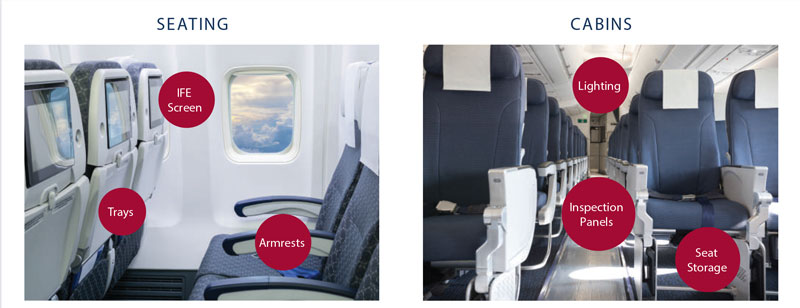
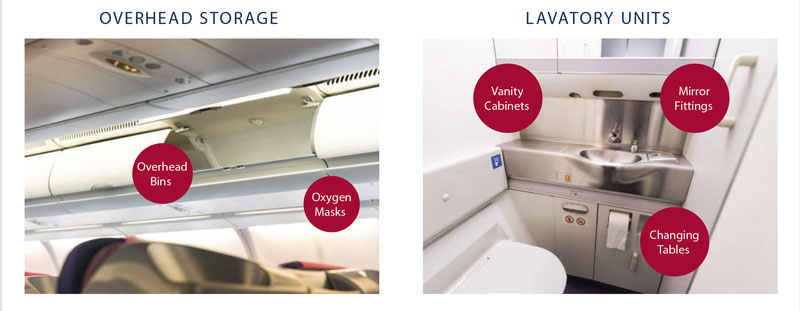
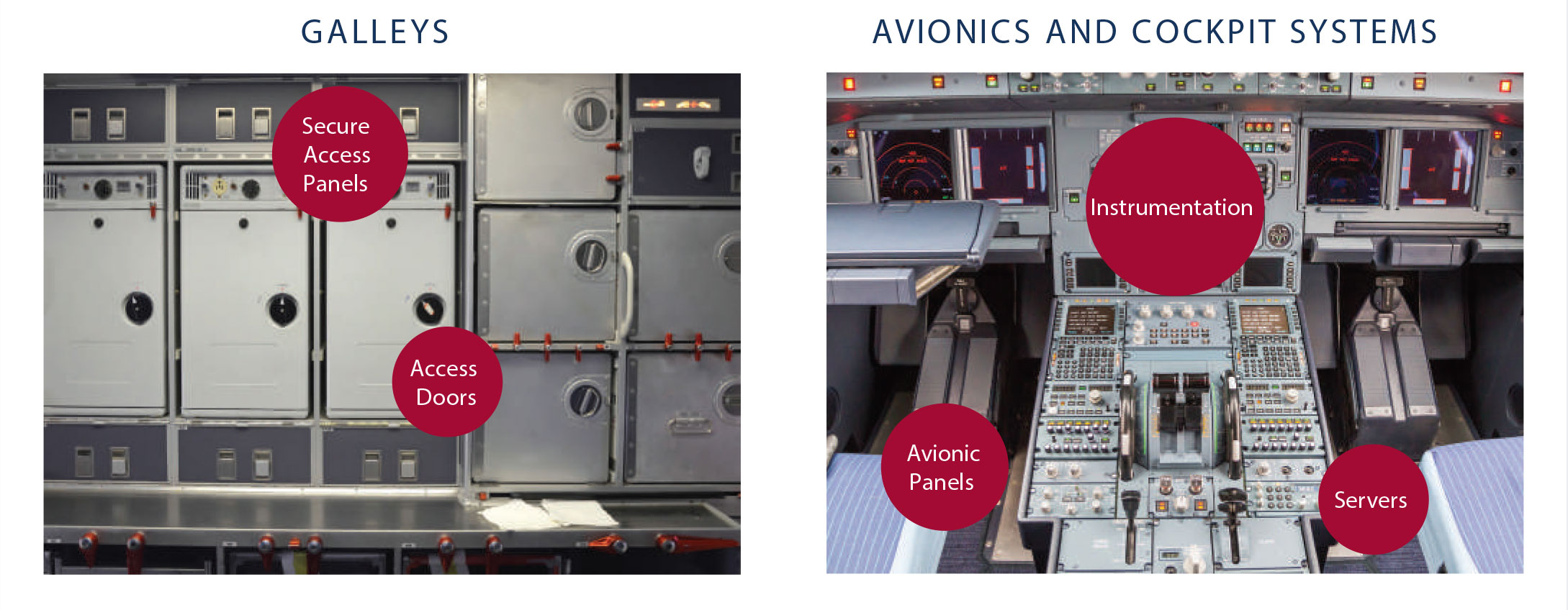
Panels that need to be opened for inspection and maintenance on aircraft must be secured safely and remain accessible when required. Quarter-turn fasteners, rotary latches and hinges can support panel opening and closing and access arrangements in suitable applications.
When selecting a product, consider panel thickness, opening direction, frequency of use, required locking method and operating environment. For a hinge, verify the load it must carry and its range of movement; for a lock, verify the retention and access requirements.
Accuride telescopic slides in aviation
Selecting the right telescopic slide for moving equipment used in aviation requires consideration of weight, load, direction of access, corrosion resistance and installation conditions. Accuride DA4165-A and DZ4180-080-035-U address different requirements. The manufacturer lists the DA4165-A for several sectors, including aerospace, while the DZ4180-080-035-U is described as a high-load industrial slide. The selection should therefore be based on an engineering assessment of whether the slide will be used on the aircraft or in ground-support and maintenance equipment.
DA4165-A aluminium two-way telescopic slide
The DA4165-A is a heavy-duty slide with a corrosion-resistant 6000-series aluminium body, stainless-steel ball bearings and a stainless-steel ball retainer. Accuride also offers the model for railway, marine and warehouse-automation applications, in addition to aerospace. The slide provides 100% extension in both directions, allowing access to the equipment from either side where the design permits.
According to the manufacturer, the slide is 26.5 mm thick, available in lengths from 400 to 1,000 mm, and operates at temperatures from -20°C to +70°C. Its load rating is up to 270 kg per pair, depending on length. For example, the technical table lists 270 kg for the 500 mm and 600 mm variants, and 205 kg for the 1,000 mm variant. The maximum rating applies when the slides are side-mounted 600 mm apart and the specified fixing points are used. The slide is not suitable for flat mounting.
The aluminium construction can be an advantage in designs where weight is a significant consideration. The corrosion-resistant body and stainless-steel moving components support long-term operation when maintenance and design conditions are appropriate. Two-way full extension can also make access and servicing easier. Depending on the project, potential applications include movable equipment drawers, service modules and access mechanisms; load, vibration and safety requirements must be verified for each application.
DZ4180-080-035-U super-heavy-duty telescopic slide
The DZ4180-080-035-U is a full-extension telescopic slide in Accuride’s super-heavy-duty range. Its main body is made of C45+C mild steel, while its balls and ball retainer are made of stainless steel; the surface has a bright zinc finish. The 10 mm diameter balls and double-T intermediate member are designed to provide controlled movement and rigidity under heavy loads.
The model is available in lengths from 500 to 2,000 mm, with an 80 mm profile height, 35 mm thickness and an operating temperature range of -20°C to +110°C. Load capacity varies according to length and installation. The manufacturer’s technical table gives the highest rating as 980 kg per pair for the 800 mm variant; this figure does not apply to every length. Slides are sold individually, and the technical data sheet does not recommend flat mounting because it reduces capacity by 81%.
Full extension makes it easier to access the back of deep equipment compartments for maintenance or cleaning. Accuride associates the model with industrial storage, transport and automation; Onurfix’s product information also gives examples of access to supporting units such as coolers, filters and motors. Within the aviation ecosystem, these features may be considered for ground-support vehicles, maintenance stations and heavy service equipment where the design requirements are suitable. Accuride’s available sources do not verify a specific aviation approval for installation inside or on an aircraft, so such use should only be considered after the relevant engineering and compliance processes are completed.
Where low weight and access from both sides are priorities, the DA4165-A may be considered; for very high load capacity, long travel and heavy support equipment, the DZ4180-080-035-U may be evaluated. Final selection for aviation should take into account the load carried by the slide, as well as acceleration and vibration, locking requirements, environmental conditions, mounting geometry and applicable compliance requirements. Consult the manufacturer’s technical team for an application-specific load calculation and installation assessment.
Onurfix aviation product groups
The ONURFIX aviation product page lists aluminium-alloy rivets, vibration-damping clips, Southco R4-EM electronic rotary latches, DZUS® quarter-turn fasteners and hinge options. Product material, dimensions and suitability should be reviewed according to the model and application.
If you are looking for rivets, panel locks or hinges for an aviation project, share your operating conditions and technical requirements with ONURFIX to learn about suitable product options. Visit the ONURFIX Aviation page to explore aviation fastening solutions.